Thursday, March 08, 2007

Back to Dolce and Gabbana


An E493 student checks in with an update to our earlier posting on Dolce & Gabbana's obscene machine ads:

From: Lindsay
Date: Thu, 8 Mar 2007 18:16:05 EST
Subject: eng. 493 article!!
To: nericcio

Dolce & Gabbana Cancel Controversial Ad Campaign

Hi Professor,
I ran across this article and thought it was something that was appropriate for our film and literature class. It's a Dolce and Gabbana ad that is being pulled from their new campaign because it depicts a sort of "fantasy rape."


I thought it was fitting for our class when I saw it's mannequin-esque models. The designers are claiming it was just supposed to depict an erotic dream, but what is erotic or dreamy about this? Just the fact that the other men are standing around the two models on the ground makes it completely offensive to me, and I believe, all women. Also the way the man is holding her down by force makes me immediately associate it with violence and rape. Just thought it was something [the class might] be interested in...

--Lindsay Steinman

Wednesday, March 07, 2007

Flor Garduño and Cristina Rivera-Garza

William A. Nericcio DRAFT

Mexican Eyegiene: Photography and the Novel in the Work of Cristina Rivera-Garza and Flor Garduño

“Matilda is constructing her paradise,” Cristina Rivera-Garza writes, and I am filled with dread. Rivera-Garza, like Vladimir Nabokov and Eduardo Galeano, and, like Luis Buñuel, devil sinematographer, is an arch-fiend of cruel irony and the “paradise” that her words etch onto our psyche will prove to be as comforting as “asylum” is in No One Will See Me Cry—that is, no comfort at all (218). “There are no eyes,” she continues, “fewer and fewer things to say.”
There are many details, but there is no plot at all to guide them or stop them or give them meaning. The ether, the façade of the theater, three stars crowning the waning quarter of the moon, the smile of a stranger, fragments of broken dolls. Nothing has significance…Tautology is the queen of her heart.”

We need assistance here. The Oxford Dictionary lends a hand: “Tautology, ORIGIN mid 16th cent.: via late Latin from Greek, from tautologos ‘repeating what has been said,’ from tauto- ‘same’ + -logos (see -logy ).” A “world of no eyes” lands Matilda in a vertiginous abyss of repetition, “a wristwatch is a wristwatch. A silk tunic is a silk tunic. The desert is just the desert.”

Stasis. Nothing moves. And as Matilda moves inexorably toward her mad fate, her decades-long imprisonment in a Mexican home for the insane, we move along with her, blindfolded, mumbling repetitions, trying to emerge from the labyrinth of mirrors (too many eyes and too much “I”) where Rivera-Garza, cruel and beautiful Cyclops leaves us.

Equally savvy, devilishly ironic, Flor Garduño treats us to a similar universe with her camera. Our eyes look quickly, somewhere and they see Gabriella in Gabriella (Mexico 1999)—we come face to face with beauty and sentience and mystery: is the veil an accessory, an adornment, or, perhaps, a shield, a means to a veiling that intends to hide a secret.


But the eyes cannot stop, Garduño’s prints exert a gentle but insistant gravity and so, no tautology, Gabriella reveals more as Gabriella reveals more—they are not the same thing--the model is not the work; the work is not the model.


Gabriella reveals Gabriella’s breasts or, again, not a tautology, Gabriella reveals Gabriella’s breasts. And, of course, tautology or not, both statements come up short because it is Garduño’s camera that has made this encounter possible, Garduño’s eye or eyes as well. And then there's the problem of the model, Gabriella, who is, as the introduction to Garduño's Inner Light tells us, more an actress than a posed mannequin; more an agent than a statue.

And, lest we forget, Rivera-Garza’s writing hand and eye for eyes must come on stage now for a bow: without Matilda, without the tragedy of her captivity outside witnessing, without voyeur, in a place where “there are no eyes,” would we have been able to have seen Gabriella and Gabriella at all.

The paradox of a novel that teaches us to see a photograph and of a book of photographs that will, like Rivera-Garza’s novel, change the way we see Mexico forever.

Works Cited

Rivera-Garza, Cristina. No One Will See Me Cry (Willimantic, CT: Curbstone Press, 2003.

Garduño, Flor. Inner Light: Still Lifes and Nudes (Boston: Bulfinch/Little Brown, 2002).

It's Wednesday, So That Must Mean Cutrufello's in the House


Date: Wed, 07 Mar 2007 13:37:29 -0500
Subject: Looks like we should have been taking Larry's sf course all
along...
From: Gabriel Cutrufello
To: Bill Nerricio
Thread-Topic: Looks like we should have been taking Larry's sf course all
along...

Hi Bill,

It's Spring Break here in Philadelphia. That means it is snowing, and I can only get enough courage up to head down the block to get some coffee. Perhaps, I should just send my robot to the library today to get research done, but I have some ethical reservations about abusing this sentient entity. Thanks to the South Korean government, we'll have some guidelines pretty soon.

-Gabe

Buñuel Screening at La Jolla's MCASD

E725 correspondent Raul checks in with a quick tip:

To: memo@sdsu.edu
Subject: Luis Buñuel
Date: Tue, 06 Mar 2007 23:51:19 -0500
From: Raul

Prof.

This movie by Buñuel would relate well to the E725 [and E493].

The Criminal Life of Archibaldo Cruz/ Ensayo de un Crimen (1955)

Maybe we could even watch a small clip of it in class--[among other things, Buñuel's opus has various scenes of] foot fetishism and mannequins.

Raul


Lastly, a quick reminder to e493 and e725 students that the film screening of Buñuel's Belle de jour is THIS Thursday at 7pm.

Martín Ramírez and Cristina Rivera-Garza


Just a pointer here to the Tex[t]-Mex Galleryblog where I have posted a piece on Richard Rodriguez and Martín Ramírez--in particular, you might want to research the work of Ramirez, whose life history dovetails nicely with the asylum settings depicted in Mexican novelist Cristina Rivera-Garza's No One Will See Me Cry. There's a detailed, additional illustrated piece on Ramírez at Antiques and the Arts Online.

Saturday, March 03, 2007

Verisimilitude, Pulp Fiction, Three Dimensions and Romance


In the spirit of Humberto Eco (arch textual fetishist extraordinaire--see The Mysterious Flame of Queen Loana),* Artist Thomas Allen combines a deft, artistic command of the x-acto knife with a sage deviant's love and understanding of all that is priceless in the realm of pulp fiction--a world where garish colors, tragic romance, science fiction, and the underworld merge into a concoction worthy of some odd tryste of Edgar Allen Poe, Lou Von Salome, and Sigmund Freud as lensed by Quentin Tarantino. The ironies of ironies here, of course, is that Miller has to destroy the objects of his love in order to create facsimiles that are more true, or, at the very least, more "alive" than the original. As the curators at his host Foley Gallery put it (twice): "Allen gently cuts around the shape of his figures, physically releasing them from their two dimensional surface. They are brought to life from their pages and covers with detailed lighting and a thin focus. Pulled and positioned, their intended drama comes to life." Holy Frankenstein, Batman! Ersatz figures "brought to life" from the paper covers of novels. This is a Borgesian wet dream without equal!

*devotees of Eco will find a nice interview with his translator here.

Friday, March 02, 2007

Melting Mothers, Cigarettes, and "the Truth"

E493 diva, Bridget O'Meara, weighs in with a critique and a movie. What do you think????

Date: Fri, 2 Mar 2007 11:15:20 -0800 (PST)
From: Bridget
Subject: The Truth
To: bnericci@mail.sdsu.edu

Hi Nericcio!

I saw something on TV that was quite offensive, or if
you will, obscene. It was slightly reminiscent of the
video of the gigantic marionette girl you showed us
earlier in the year. Not everyone will see me eye to
eye on this, but I think all can agree that this
commercial, in the very least, is disturbing.
The Truth (you know, the anti-smoking campaign) came
out with a commercial that, on first glance, I thought
was an anti-abortion advertisement. Their whole point
is that over 30 children a day lose their moms to
smoking. But the impression the commercial gives is
that female smokers kill their babies (and, as for
themselves, melt away like the Wicked Witch). The way
The Truth chooses to portray smokers as 'ice cold' is
pretty twisted.

I find it rather upsetting because I have a good
friend whose mother died from smoking-related cancer,
and I hope he never sees this. His mother was not an
object that one day just dissolved without a sound or
emotion.

Here is the link or watch it just below...

Bridget O'Meara

Temple University Robotics Graduate Student Checks in Again!

Our East Coast correspondent, Gabe "iRobot" Cutrufello just can't stop himself when it comes to dispatches for the ObsceneMachine Blog, especially when it comes to a tale that weaves his twin fetishes: one literary, Philip K. Dick; the other, er, cyborgic, robots! Here's Cutrufello's piece, hot off the presses:

Date: Fri, 02 Mar 2007 01:15:33 -0500
Subject: Ok, Ok, I'll stop I promise...
From: Gabriel Cutrufello
To: Bill Nerricio

Hi Bill,

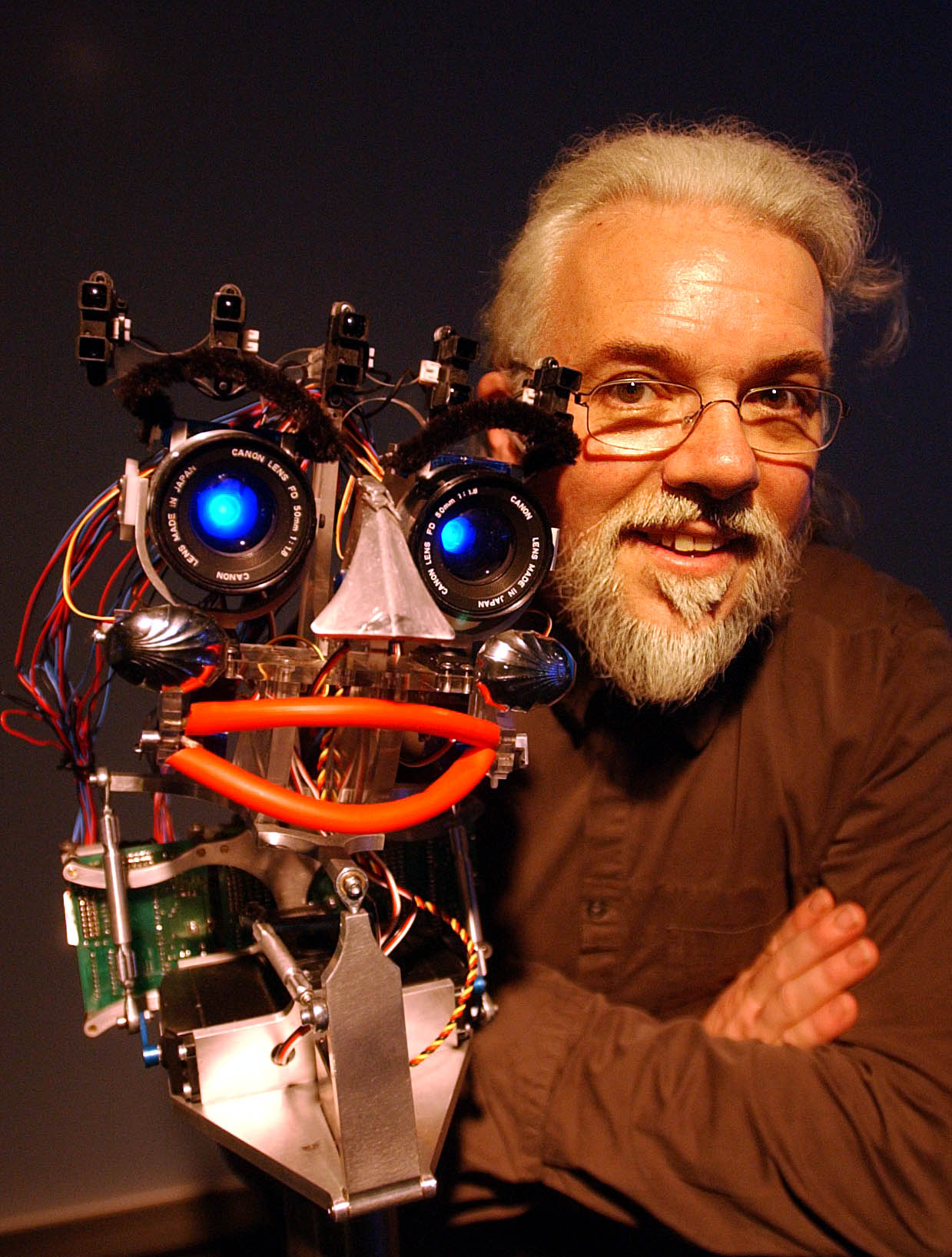
It may come as no shock to you that what graduate students like to do at 1AM is look for information about the Philip K. Dick android project. This is slightly old news (about two years ago), but Hanson Robotics created an android Philip K. Dick. Check out the way in which they create the interactive personality: "IIS will create the artificial intelligence personality of the robot by mathematically deriving it from Dick's life and works in a manner very similar to that described by Dick himself in his book We Can Build You (published in 1964)." Here are two links: one and two.

And here is a really great picture of the PKD simulacra with the back of its head removed:


Best,

Gabe

PS – I read the post on the Doctor Who Cybermen (really great). Being the sf fanboy/”scholar” that I like to imagine myself, I have to recommend the new Battlestar Galactica and its take on the Cylon (its version of the simulacra).

Thursday, March 01, 2007

CYBERMEN and Doctor Who

Ana Aguila Reyes beams down with a sci-fi posting of no little interest for obscene machine devotees:

From: Ana Aguila Reyes
Subject: question
Date: Thu, 1 Mar 2007 14:20:58 -0800
To: b. nericcio

Hi, professor. A while back I had a conversation with a friend about sickness and our bodies. The question of Why we were made so fragile came up. For anybody who has had an illness or has known someone who is sick, we sometimes wish we were made of some other material other than flesh in order to avoid pain and suffering. In my conversation metal came to our minds. What if humans were made of metal? No more sickness. Linking this type of thought to the reading on Rita Hayward, it seems that people try to escape from they’re problems by becoming someone or something else. The excuses are endless.

One of my favorite sci-fi shows, Doctor Who, brought this theme up in one of their shows with the Cybermen. The Cybermen were once human like us but have received the ultimate upgrade. Their human brains welded into their cybernetic bodies which have been adapted so that the Cybermen are utterly devoid of emotion.

Here’s a clip of the Cybermen:


... and a photo as well!


Courtney Yip Checks in With a Question for the Class...

From: Courtney Yip
To: bill nericcio
Subject: for the blog!

Hey Bill! Being a film major, you may understand why I immediately thought of a movie after talking about the use of shit in Eco's wonderful book. Babel is another flick that would be great to talk about in our class (especially since it directly involves the tijuana/san diego illegal immigrant stereotypes, along with many more). There is a scene that Brad Pitt and Cate Blanchett share after she has been shot by one of the two young Moroccan children (a whole other story). Before this moment, this husband and wife have been arguing and not getting along at all. Towards the end of the film it looks like she may not survive, and she turns to Pitt and says, "I peed myself". They smile for the first time with each other, and she says that she has to go again. Pitt brings a pan over to her and since she can barely sit up, they embrace and hold each other in this moment of true love. As she pees, she finally looks into his eyes, as if remembering everything that was truly important (as if her peeing was a reminder of the basics in life - bodily functions, her husband, love ...) She cries and tells him she loves him. Really moving.

I was amazed at this scene. You truly have to see it to understand what the director Inarritu was trying to convey, perhaps along the same lines as Eco: shit and piss, memory and love. Does anyone agree with me, who has seen this film?

- Courtney Yip

some photos can be seen here, here, and here.

Wednesday, February 28, 2007

Jim Ricker tells the tale of Carmen Mesta


Cultural Studies maven and SDSU graduate student Jim Ricker has been watching The Young and the Restless lately (God help him!) and has run across a character, Carmen Mesta, whose intrigues evoke the contours of our Tex[t]-Mex adventures. Click here for the full scoop!

Tuesday, February 27, 2007

Wherein Percy Bysshe Shelley Makes an Unexpected Cameo


Nothing against robots and cyborgs, they are, if anything, the life's blood of this blog, but Romantic Poet poster child Percy Bysshe Shelley was no fool, and what he has to share here, in a selection from Queen Mab, is sobering and inspiring.

The Obscene Machine Goes Tex[t]-Mex and Chinese


E493 reporter Melissa Soltman checks in with a report that spans the Rio Grande River to the Yangtze!

Date: Tue, 27 Feb 2007
From: "Melissa Soltman"
To: "Bill Nericcio"
Subject: blogs

Hi Professor Nericcio,

I stumbled across some interesting Tex[t]-Mex situations that I wanted to bring to your attention. I was at an award ceremony for my friend at UCSD, and a Professor Paul Pickowicz gave a lecture on his first visit to China in 1971, when there were no diplomatic relations between the US and China. It was right at the time of Mao's Great Proletarian Cultural Revolution. He bought many posters home with him that were propaganda posters during the revolution. He said that a lot of people today think they are funny, and while the stereotypes show him why people laugh, at the time they were very serious. Sometimes intentionally, they show many mostly hidden aspects of Chinese life during the cultural revolution. The posters resemble those in your opening chapter of Tex[t]-Mex and reflect your argument regarding stereotypes, how engraved in society they are and their consequences. I also thought it was interesting that two countries (US and China) can actually be linked socially when they had nothing to do with each other diplomatically.... Anyway, I thought these might be class worthy. ...


Dare Wright, Dolls, Photography, and the Psyche


Ace e725 Correspondent, Tria Andrews, checks in with a moving and evocative dispatch that fuses select, nuanced elements of our seminar's obsessions:

From: "Tria Andrews"
To: bnericci@mail.sdsu.edu
Subject: e725 Dare Wright


Dr. Nericcio,

I have recently finished reading a wonderful biography--Jean Nathan's The Secret Life of the Lonely Doll: The Search for Dare Wright. The biography is not only fascinating, but entirely relevant to our course studies. Dare Wright wrote a series of morbidly enchanting children's books in which she photographed dolls and stuffed bears. She also, like Cindy Sherman (whom another classmate wrote in about earlier this semester), took many self-portraits, some of which she appeared arguably as herself and others, in which she appeared as someone else--muse, mermaid, dead girl.

Wright's life is highly problematic. As a child, she posed for countless hours while her mother, a renowned artist, painted her photograph. The two had a close--almost incestuous relationship. Wright, who never married and eventually lost her mother was, as the title of the biography points up, herself a lonely doll. Friends of the Wrights recall that they were always hungry when visiting. Mother and daughter were not interested in food or even so much social interaction as they were at playing elaborate dress up. Wright even painted the floor of her apartment so that it appeared to be black and white tile and not the hardwood that it was. Visitors marveled at the realism of the facade.

The woman, the woman-child, and the child as doll. What could be more relevant to our discussion than a real life example? And the entrapment of Wright, her sad, sad decline as she and her mother aged--could no longer continue their respective rolls--is none other than tragedy.

I do hope some people will look into Dare. She is one of my favorites.

Tria

Friday, February 23, 2007

The Robot that Feels


literature.sdsu.edu MA alum and Temple University PhD-stud. and obsceneMACHINE correspondent at large, Gabriel Cutrufello, checks in with a salient link on emotional robots:

Date: Fri, 23 Feb 2007 12:28:57 -0500
Subject: Emotional Robots
From: Gabriel Cutrufello
To: Bill Nerricio

Hi Bill,

I hope all is well. I just ran across this article in the BBC online. They haven't happened yet, but apparently there is a firm commitment to create these emotionally responsive robots.

Best,

Gabe


The professor running this affect-laden robotics research is Lola Cañamero. Another related researcher is here.

Wednesday, February 21, 2007


Ace London correspondent and musician Lauren Brennan checks in with this report

Date: Wed, 21 Feb 2007 02:37:22 -0800
From: Laura
Subject: possible blog entry for E493
To: bnericci@mail.sdsu.edu


Greetings, Profe! I don't know if this is quite what you had in mind for a blog entry fit for class consumption, but I hope so! I was recently introduced to the art of Julian Beever, an internationally renowned sidewalk chalk artist, best known for his use of perspective and optical illusions in his work to simulate three-dimensional objects or scenes on the sidewalks of London. Not quite along the same lines as giant puppets or racist robotics, I know, but ever since I first glimpsed this guy's work I knew I wanted to bring it up for the class to see, and not just because it's pretty amazing to look at. I think Beever's art deserves to make its way into the Obscene Machine's collective consciousness because of the immersive nature of his sidewalk works. People walking by his art are immediately drawn into his world (no pun intended), the false reality he's creating to trap people, literally, at a pedestrian level; snatching the ground out from under the passers-by on the street around him and using it as a canvas. I've attached a couple of my favorite pieces, but the entire site is worth a closer look.


As impressed as I continue to be by the waterfall scene, I especially think that his self-portrait/still life of he and his chalk doppleganger drawing together works particularly well with our art-as-ersatz-humans angle. For an added level of weirdness, take a closer look at the beer bottles - which one is two-dimensional again? ;)

Also, here's Beever's official website and here's a link to a BBC article about him:

Thanks, Nericcio!

Laura Brennan

Wednesday, February 14, 2007

dolce gabbana and the allegory of birth

The March 2007 issue of Elle Magazine features a couple of ads that work as utter embodiments of the driving sentiments fueling our obscene machine adventure. Ad 1, seen here, presents us with an odd, next-century allegory of birth worthy of Renaissance tapestries. Note the mannequin-esque makeover the human models are swathed in; note, as well, the parody of birth enacted with the lifted model's leg and her "human" issue in the glass box!

AD 1


Ad 2, below, is more vulgar and immediate--in it one sees something I have come to call eyegiene--a neologism, or manufactured word, that fuses the noun for the optic organ, with all its attendant semiotic intrigue, with the butt-end of the word hygiene, giene, signifier of all things septic and clean. The undecide-ability, the overdetermination, of the phallic signifiers (which is more cock-like, the camera as ersatz phallic "cock" or the cock as camera wanna-be) provides a drama worthy of Jekyll and Hyde.


To be frank, this is an illicit neologism, and I like it that way, guided more by the vagaries of homonymics, eyegiene sounds like hygiene, that any sophisticated philological conjuring!

AD 2

Tuesday, February 13, 2007

Jessica Rabbit, Meet Speedy Gonzales

Correspondent Tria Andrews writes in with an animated finding:

From: "Tria Andrews"
To: memo@sdsu.edu
Subject: Re: "I'm just drawn that way." (725e)

Professor Nericcio,

Tonight television trivia and the chapter from Text{t}-Mex, "Autopsy of a Rat," happened to conflate. The trivia question: "What animated character says, 'I'm not bad. I'm just drawn that way?'" Answer: Jessica Rabbit. What could be more perfect or timely? This meta statement is in fact a synopsis (I think) of the discussion of Speedy Gonzales and even of Isadore Freleng or I. Freleng or Friz Freleng and his work at Warner Brothers, where he--perhaps purposefully, perhaps unconsciously--perpetuated stereotypes when he himself was a victim of anti-Semitism. Furthermore, is not the artist speaking through Jessica Rabbit (and we all know what rabbits are notorious for)? As Tex[t]-Mex argues, the author is the art--that is, the art is what the artist sees, what the she knows, the artist herself. Rephrased, the artist might say about objectified sexpot, Jessica, "'I'm not bad. I just draw that way.'"

Tria


UPDATE

Another student advancing the argument of Speedy, Friz and his ilk with a decidedly John Bergerian view is Sarah Smorol. Let's listen:

From: sarah smorol
To: bill nericcio
Subject: textmex, the treachery of images
Date: Tue, 27 Feb 2007 22:29:59 -0800

Dr. N.- here is something that ties in with the Tex[t]-Mex Blog-- look at these images:


Here is a painting titled The Treachery of Images by Rene Magritte. This painting inspired an essay of the same title by Michel Foucault. The depiction of the pipe is accompanied by the French words reading "This is not a Pipe". It is a painting of a pipe, of course, but it goes deeper; Magritte and Foucault explore the way that we are beholden to the visual. By this logic we might see how the visual representations we absorb, (think Speedy), fool us into cemented definitions. The Treachery of Images indeed. Magritte and Foucault understood this process and sought to chip away at the seeming reality of images and promote instead a more questioning perception of what we see, (are shown?). When considered in the context of the stereotypical images in Tex[t]-Mex which read "not Mexican", "not African" or "Not Chicano", the same loosening of dogmatic mortar happens in our minds.

Monday, February 12, 2007

Victoria's Secret Mannequin Fetish


An e725 Graduate correspondent weighs in with a story of no little interest to readers of this blog! That's right! It's mannequin time again!

Date: Fri, 2 Feb 2007 14:55:30 -0500
From: heather galan
To: bnericci@mail.sdsu.edu

Bill,

I have a friend who worked at Victoria's Secret when they came out with their new mannequins, who told me that each mannequin cost $8000, which sounded absurd, but they are the most intense retail mannequins I've ever seen. As if the models in the catalogues and runway shows aren't enough these tactile representations of Naomi and Gisele always make me feel like they are encroaching on my personal space. They hover over me as I shop for underwear displayed around their infinite legs. Talk about "sex sells" but also the eerie attention to diverse skin tones but without any regard for variation in the body shapes. I found an article about them that is interesting; Also the website for the company that made the mannequins is disturbingly fun--building a life-size really expensive Barbie, essentially. Thanks and see you next week, Heather Galan

Meta[l]morphoses

One of our colleagues in e725 forwarded this powerpoint meditation on cyborgs, etc--do note that you will probably have to have powerpoint on your system to view the link above. Here's the note that accompanied the attachment:


From: sarah smorol
To: "bnericci@mail.sdsu.edu"
Subject: FW: Meta(l)morphoses.ppt

Hello- classmates- this link is to a powerpoint presentation I did based on gendered technology and cyborgs. The images and order are done by me but the ideas are all based on Rosi Braidotti's book Metamorphoses:Towards a Materialist Theory of Becoming. MA: Polity, 2002. Braidotti argues that we are already cyborgs(plastic hips, pace makers etc) and also points out that those who control tachnology shape our future. From the perspective of gender studies then women must participate in these fields if they are to change the power dynamics of the future- one example- if daryl hannah plays the "basic pleasure model" cyborg in Bladerunner, (they actually call her this) then we might assume that men are designing the cyborgs. The same could be applied to any marginalized, (not marginal), population. The attachment this link goes to explores these issues with many movie images to support the ideas- that is tot try and prove that popular culture, which is dominated by cinema, is used to shape our ideas about what the future will be- by creating new representations women/ chicano/ disabled or otherwise, etc., creators (writers, producers, moviemakers for example)can change that future.